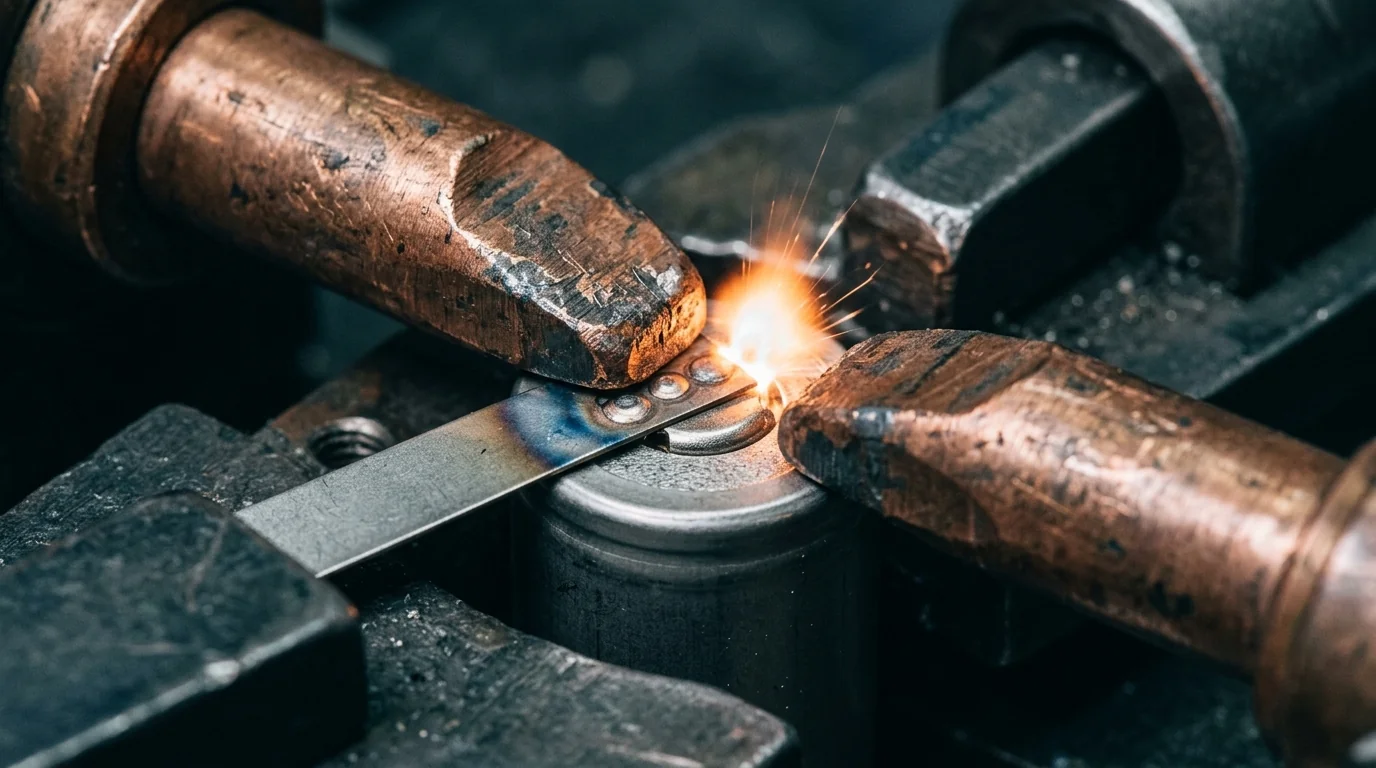
Resistance spot welding drives a controlled current pulse through the overlapped joint, fusing it in milliseconds through the metal's own resistance. It's the process buyers reach for when volume climbs, cycle time matters, and per-part throughput has to stay steady across a production run.

Reach for resistance spot when the parts overlap, the joint is small, and current can pass cleanly through both sides.
Nickel or copper tabs onto cell cans, bus-bar terminations, and terminal-to-lead welds inside prismatic and cylindrical cells. Each pulse forms a low-resistance contact. See battery packs.
Fine wires, magnet-wire enamel burn-through, and ribbon bonds onto pads or pins. Coating burns off first, then metal fuses to metal. See wire and ribbon bonding and coil winding.
Controlled bead formation on K-, J- and T-type wire, and matched-alloy junctions where the two legs meet. See thermocouple work.
Millisecond cycles with cycle-to-cycle repeatability, so the joint at end of shift matches the one at start.
Resistance spot is the wrong process when you need a seamless cosmetic weld or a hermetic seal. That work belongs to laser micro welders, which run autogenous with a fine seam and no visible mark. It's also not the pick when you need to add filler, bridge a gap or rebuild a worn dimension; pulse arc / micro TIG carries the wire and pulse control that job needs. If you only need a serial or logo, laser marking is a different machine class. One honest note: electrodes are the core consumable and tip shape drives weld quality. Plan a steady dressing cadence and keep the restock loop through electrodes and consumables.
See how this compares against the other processes for your material and volume.
Three families cover most resistance spot work. Pick by throughput, part size and how the line is fed.
| DC / Capacitor-Discharge | AC transformer | Inverter / Mid-frequency DC | |
|---|---|---|---|
| Form factor | Bench cabinet with programmable head | Rocker-arm or press-type frame | Cabinet with gantry-fed head |
| Operator | Manual or foot-pedal, indexed | Manual, foot-pedal | Programmed or robot-fed |
| Part size range | Very small to palm | Mid to larger cross-section | Small to mid assemblies |
| Throughput | Low to mid, high-mix work | Mid volume, mixed shop lines | Mid to high, production cells |
| Best-fit application | Battery cell tabs, electronics, thermocouples | Specific alloys, thicker parts | EV battery packs, sensor production lines |
| Automation | Fixture and PLC ready | Fixture ready, limited robotic | Robot and PLC handshake ready |
| Footprint | Compact bench | Freestanding frame | Full cell |
The spec lines that decide whether a resistance welder fits your part.
That's a lot of variables. Send us your part and we'll come back with a recommended configuration and a test weld.
Send my part for evaluation →Four steps we walk through with new buyers:
Materials on each side, thickness, throughput and whether the line runs batch or continuous.
Representative tabs, wires or terminal pairs that would run on the actual line.
DC/CD, AC or inverter recommendation, electrode class and tip shape, force and current envelope, cycle time.
A small trial run through the machine before you commit to the full order.
Post-shipment, an engineer stays on the account until current, force and cycle for your part are locked in.
Electrode holders, indexed jigs, cell-alignment fixtures and pack cradles matched to the part.
Resistance spot carries the highest ongoing electrode need of the four processes we sell; a steady restock loop through electrodes and consumables matters more here than on the laser side.
Remote onboarding for operators, with parameter walkthroughs, dressing procedure and recorded sessions.
Standard machine warranty, configuration dependent. Extended plans on request.
Test welds available before you place the order.
No obligation. Physical parts or photographs.
Bench DC/CD ships in weeks; custom cells run longer. Exact bracket given with the quote.
Deposit up front, balance before shipment. Trade references for repeat accounts.
Cell tab, terminal and bus-bar welds on cylindrical and prismatic cells.
See battery tab welding →Contact welds, wire-to-pad joining and subassembly work.
See electronics joining →Thermocouple beads, sensor pin welds and connector assemblies.
See automotive applications →Thermocouple work and connector welds where traceability matters.
See aerospace applications →Send the part. We test-weld, log parameters and return them before you commit.
Laser, pulse arc / micro TIG, resistance spot and laser marking through one account.
For dealers who need their brand on the equipment, we scope private-label lots.
Electrode dressing and force tuning is where a production line lives or dies. Handling it through one supplier keeps parameter history and spare stock in one place.
If evaluation shows your part is better served by a different process, even one we don't sell, we tell you. We'd rather lose the order than ship the wrong machine.
You don't get handed off after shipment. We stay with your operator until current, force and cycle for your part are set. Otherwise we haven't done the job.
Class 2 copper electrodes, dressing tools, force-transducer service and fixture spares through our supply chain, so downtime after year one doesn't drag on.
Depends on material and electrode class. Nickel tab work sits in the thin-foil range; heavier terminals shift to larger frames and higher force. Send a sample and we'll test-weld before recommending a spec.
Yes. Copper-to-nickel is one of the most common dissimilar pairs in pack work. Short high-current pulses with careful electrode force keep copper's conductivity from stealing heat.
Depends on material, current and duty cycle. Coated steel and copper wear tips faster than nickel. See electrodes and consumables; dressing is a recurring line item.
Depends on duty cycle. Low-duty bench work runs fine air-cooled; continuous production lines usually want water-cooled holders so tip geometry stays put.
Resistance spot fits high-volume tab, wire and terminal work; laser fits low-distortion seams and hermetic seals; pulse arc fits filler work. See How to Choose.
We test-weld your part and return parameters, a cross-section photo and a process recommendation before you commit.
Prefer to request a quote?