Pulse arc, or micro TIG, puts a fine, controlled arc pulse into the joint with filler wire fed by hand or feeder. It's what buyers reach for when a laser's autogenous joint won't do the job — material to add, a gap to bridge, or a subassembly to tack.

Reach for pulse arc when the joint needs filler, a gap has to close, or a repair calls for a localized deposit on a small high-value part.
Wire feeds into the puddle to bridge gaps, close porosity or rebuild worn edges, while short pulse duration keeps bulk heat out of surrounding metal.
Tool tips, worn insert edges and framework repairs sit inside pulse arc's window. See mold and die repair and dental labs.
Hold a subassembly in place before the final process, so the finishing pass goes down clean.
Short pulses with argon shielding put energy into the joint without cooking the wall. On titanium, coverage from the shielding gas guide keeps the bead clean.
Pulse arc is the wrong process when you need the smallest HAZ on thin walls or heat-sensitive assemblies. That work belongs to laser micro welders, which run autogenous and keep heat very tight. It's also not the pick for high-volume dissimilar-thickness sheet stacks, where resistance spot is faster and more forgiving. If you only need to mark a serial or logo, laser marking is a different machine class. Argon consumption and electrode wear are two ongoing costs pulse arc carries and laser does not; factor both into total cost of ownership.
See how this compares against the other processes for your material and volume.
Pick by part size, throughput and how the operator interacts with the machine.
| Benchtop pulse arc | Weld-head style (integrated stand) | Portable pulse arc | |
|---|---|---|---|
| Form factor | Enclosed cabinet + stereo microscope | Integrated stand, foot-pedal | Handheld torch, transformer cart |
| Operator | Manual, microscope-guided | Seated at stand, pedal-controlled | Handheld, cable-fed |
| Part size range | Very small to palm | Small to mid frame | Small to large frame |
| Throughput | Low to mid, high-mix repair | Mid volume, mixed shop work | Field or shop, low to mid |
| Best-fit application | Detail repair, dental, tool tips | Framework build-up, general repair | Field repair, awkward on-site work |
| Automation | Manual only | Manual with fixtures | Manual only |
| Footprint | Compact bench | Stand cell | Movable, minimal fixed |
The spec lines that decide whether a pulse arc machine fits your part.
That's a lot of variables. Send us your part and we'll come back with a recommended configuration and a test weld.
Send my part for evaluation →Four steps we walk through with new buyers:
What you're adding, filling or building up, base material and filler alloy if you already know it.
We tack, fill or build it up and photograph the result.
Which family (benchtop, weld-head, portable), which electrode, which filler stock, which gas mix.
A small trial run through the machine before you commit to the full order.
Post-shipment, an engineer stays on the account until electrode, pulse current and gas flow settings for your part are locked in.
Custom holders, indexed jigs and stage attachments matched to your part.
Electrodes are wear parts on pulse arc, unlike laser. A steady restock loop through electrodes and consumables keeps the line running without emergency orders.
Remote onboarding for operators, with parameter walkthroughs and recorded sessions to replay.
Standard machine warranty, config dependent. Extended plans available on request.
Test welds available before you place the order.
No obligation. Physical part or photograph.
Standard benchtop ships in a matter of weeks; portable and custom stand configurations run longer. Exact bracket given with the quote.
Deposit up front, balance before shipment. Trade references available for repeat accounts.
Framework repair and cobalt-chrome build-up on prosthetic parts.
See dental lab welds →Localized repair on machined parts where a full re-machine is uneconomic.
See aerospace welds →Edge build-up with matched filler, restoring worn geometry.
See mold and die welds →Small tack welds on subassemblies before soldering or bonding.
See electronics joining →Send us the part. We test-weld, log parameters and return them before you commit to a machine.
Laser, pulse arc / micro TIG, resistance spot and laser marking, through one account.
For dealers who need their brand on the equipment, we scope private-label lots.
Pulse arc has an ongoing electrode need laser doesn't. Restocking through the same account keeps paperwork and supply simple.
If evaluation shows your part is better served by a different process, even one we don't sell, we tell you. We'd rather lose the order than sell the wrong machine.
You don't get handed off after shipment. We stay with your operator until the pulse settings, electrode choice and gas flow for your part are set. Otherwise we haven't done the job.
Electrodes, argon flow parts, filler stock and contact tips are available through our supply chain, so downtime after the first year doesn't drag on for weeks.
Pulse arc is TIG at a smaller scale, with much shorter pulses and finer current control for high-value small parts. Regular TIG is built for structural work; pulse arc is built for repair, build-up and tack welding under a microscope.
Yes. Edge build-up with matched filler is one of the most common applications. Because pulse currents stay small, surrounding heat treatment usually isn't disturbed, though preheat still helps on brittle stock.
Yes. Argon is the baseline, and shielding coverage saves the weld on reactive metals. See the shielding gas guide for setup metal by metal, including post-flow to prevent cool-down oxidation.
Depends on material, current level and duty cycle. High-current tool steel work grinds tips faster than low-current stainless. See electrodes and consumables; the honest answer is that electrodes are a recurring line item.
Pulse arc fits when you need filler, close a gap, or rebuild a worn dimension. Laser fits when the joint is autogenous and heat has to stay off surrounding features. See How to Choose for a walkthrough across all four processes.
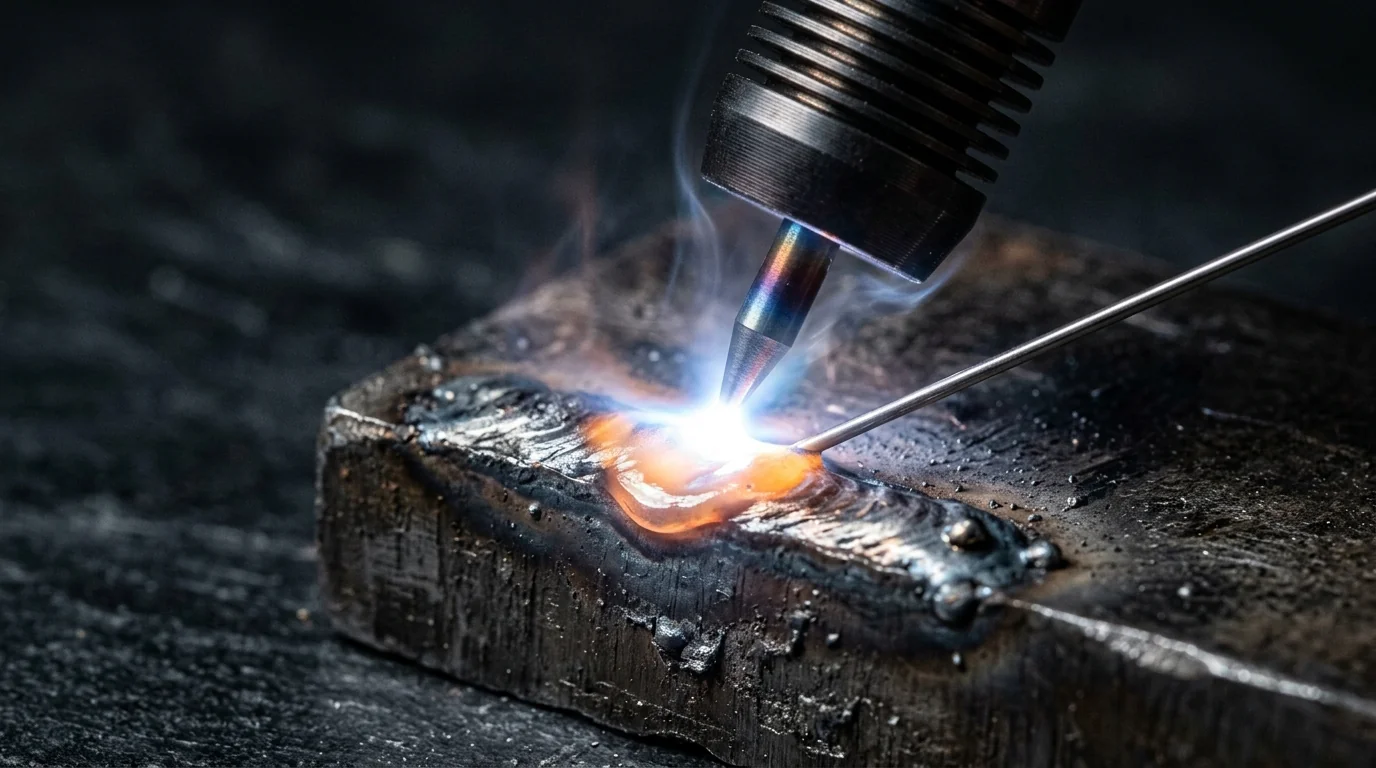
We test-weld your actual part and return parameters, a cross-section photo and a process recommendation before you commit to a machine.
Prefer to just request a quote?