Free weld sample evaluation — send us your part, we test-weld it before you commit.
HomeApplications › Electrical Connections and Fuses
Applications · Electrical connections and fuses

Electrical Connection and Fuse Welding

Electrical connection and fuse welding covers the interior joints of protective devices and current-carrying assemblies — fuse element to end caps on blade, cartridge and blow fuses, terminal-block lugs, busbar-to-busbar bonds, relay contact tips and contactor terminals. Contact-resistance stability is the acceptance criterion, and the fuse’s calibrated blow characteristic must not shift under weld heat.
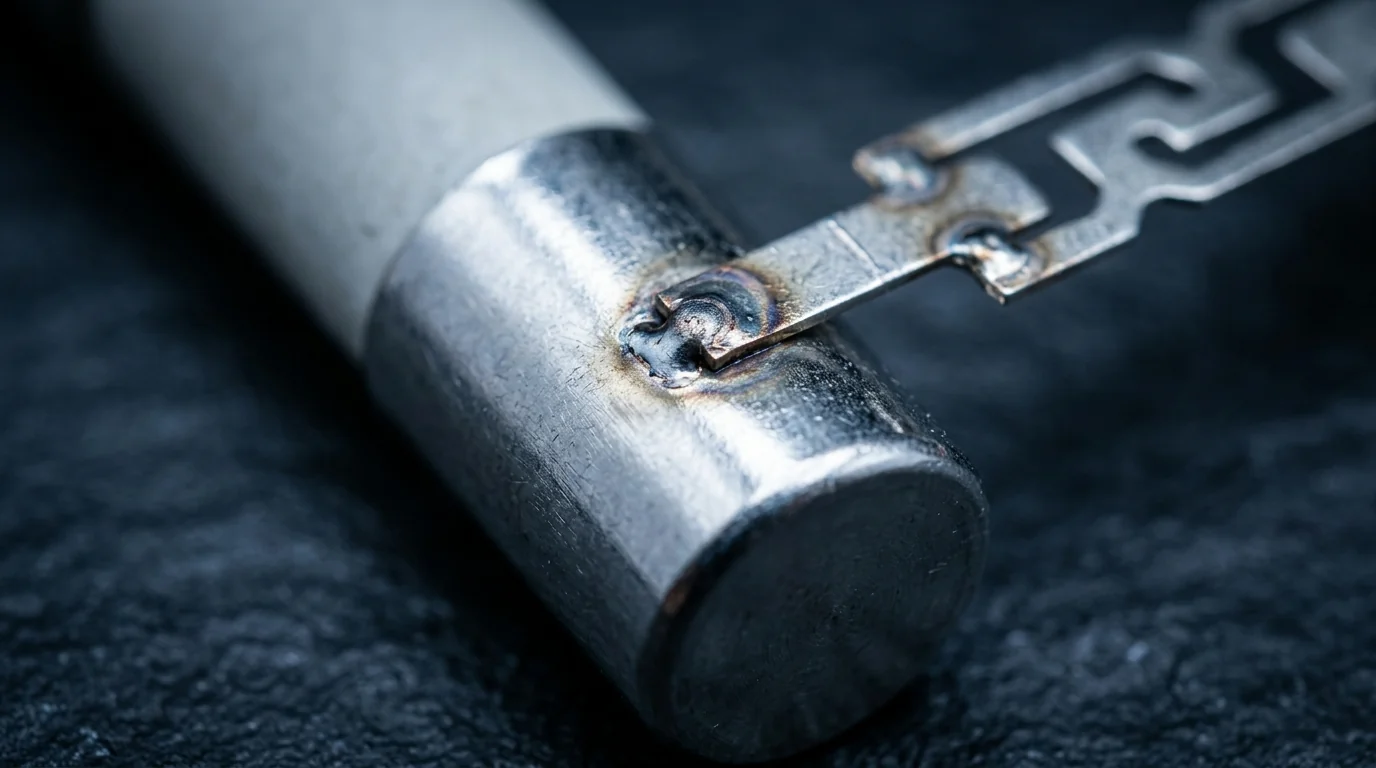
Cylindrical ceramic cartridge fuse body with a zigzag fuse-element strip welded onto its metal end-cap, close-up on a dark textured surface
Typical joints

Typical electrical connection and fuse parts and joints

Process fit

Which process fits electrical connection and fuse welding

Resistance welding (dominant on fuse and terminal work)

Workhorse for fuse element to end cap

Millisecond pulses at controlled force fuse the joint while keeping heat away from the fuse element itself, preserving its calibrated blow characteristic. Also the workhorse on terminal-lug and contactor terminal welds where both sides pass current cleanly. Projection welding on knife-blade and larger bolted fuses puts current density exactly where fusion is intended. See the resistance line →

Laser (SMD fuses, precision contact tips)

Miniaturized cases and dissimilar-alloy tips

Fits SMD fuses, high-density contact tips and cases where the surrounding assembly cannot accept two-sided electrode access. Laser puts small controlled energy into the joint without needing a bottom electrode, and handles dissimilar-alloy tips (silver-alloy to copper base on relay armatures) where a single resistance recipe cannot balance the two melting points. See the laser line →

Pulse arc / Micro TIG (occasional, not primary)

Not the primary fit for calibrated fuse elements

Arc heat exceeds what most fuse elements can tolerate near the current-carrying section, but pulse arc appears on repair scenarios and on some terminal-block work away from calibrated fuse elements. See the pulse arc line →

Because contact resistance is the acceptance criterion and fuse blow characteristics are set at manufacture, sample builds run through the customer’s own resistance measurement and blow-characteristic verification are the acceptance step that locks the process choice.

What’s hard

Common difficulties in electrical connection and fuse welding

Electrical connection and fuse welds get judged by the customer’s own resistance and blow-characteristic test, not by weld appearance. The most reliable way to lock parameters for a specific fuse or contact assembly is a sample build run through that test. The evaluation itself is free.

Send a sample for free evaluation