Continuous seam welding fuses two edges into a single leak-tight line — the process behind welded tube from a strip mill, cylindrical enclosure closures, can end-cap seams, and bellows convolutions. The hard part is not any single spot; it is holding overlap, current density and thermal state constant across the full length of the seam. On the acceptance side, leak-tight means no gap between overlapping fusion spots along the seam, verified by helium-leak, pressure-decay or dye-penetrant testing on the finished part.
Seam sealing covers a broader parts universe than diaphragm sealing — anywhere two edges close a cavity and need to hold pressure, vacuum or a controlled internal atmosphere without a mechanical gasket. The recurring joint forms are:
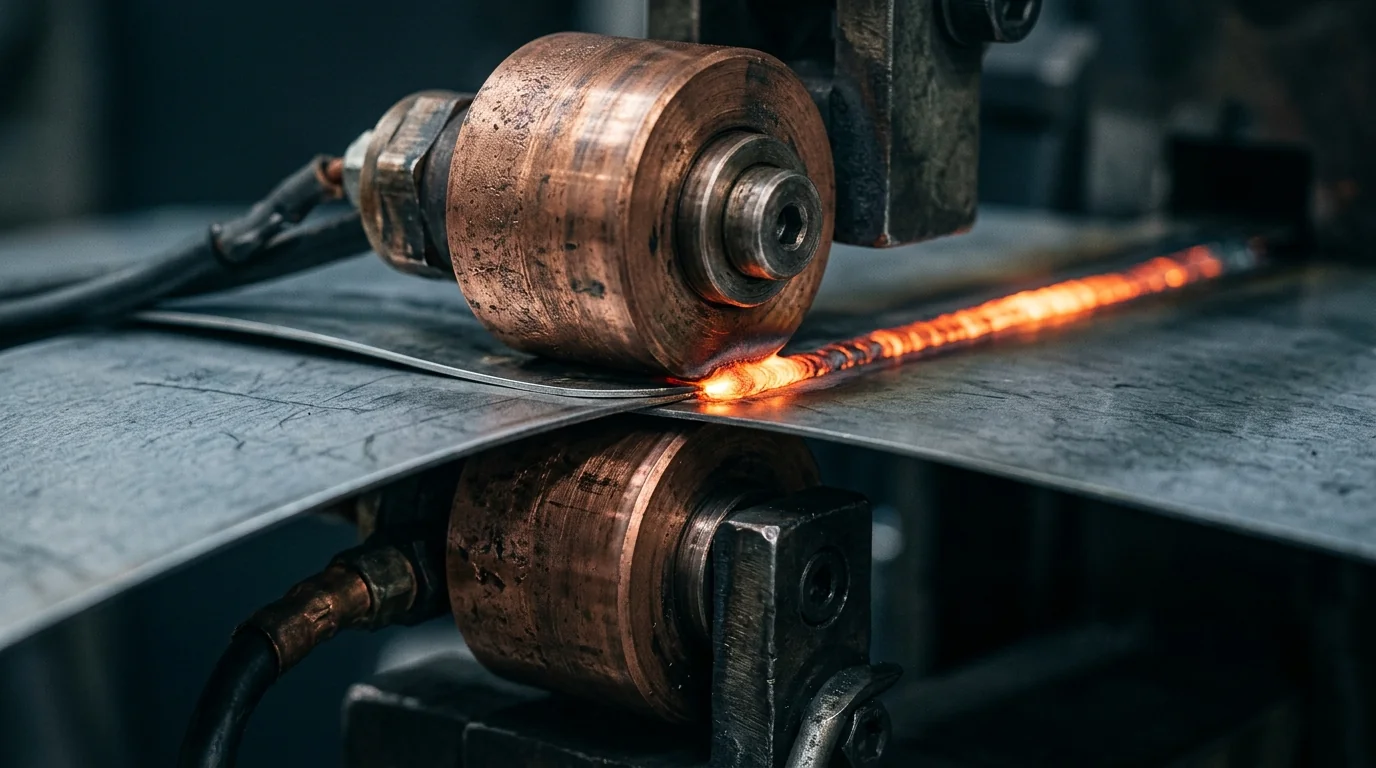
Roller-electrode seam-welding heads roll along the joint line, laying down a continuous overlap-controlled fusion pattern spot by spot. Force, pulse timing and roller speed together lock the overlap distance across thousands of consecutive spots — the setup that carries volume production on can bodies, welded tube from strip mills and cylindrical enclosure closures where the geometry stays predictable across the run. See the resistance spot line →
Continuous or overlapping-pulse laser seams sit on thin-wall enclosures where a roller electrode would deform the substrate under mechanical force, and on hermetic package lids where an autogenous weld gives the tightest leak-path control. Precision pulse timing holds heat accumulation within the local seam’s tolerance across long runs. See the laser line →
Pulse arc / micro TIG covers the smaller cross-section repair role — re-fusing a leak point on a fielded enclosure, laying a filler bead across a bellows convolution, or hand-guiding a precision seam on a one-off build where a full production setup would be over-invested. Weld visibility during setup also helps on non-repeat geometry. See the pulse arc line →
Acceptance sits downstream of the weld line — helium-leak, pressure-decay or dye-penetrant testing on the finished part is what confirms overlap consistency held across the full seam, and a sample run through the same test flow is the quickest way to lock the process choice for a given geometry.
Four difficulties dominate seam-sealing programs, all traceable to one fact — a seam is not a single weld but many welds in sequence with cumulative state carrying forward from spot to spot:
Seam-sealing acceptance is decided by the leak test, not by how any single spot looks. The reliable go/no-go is a sample seam on the actual enclosure geometry followed by a leak test — helium-leak, pressure-decay or dye-penetrant — in the same flow the finished part will see. The evaluation itself is free.
Send a sample for free evaluation