Projection welding uses preformed projections on the workpiece itself to concentrate current at multiple predetermined points, so several projections fuse simultaneously in a single pulse — a fundamental departure from ordinary spot welding. Typical work is weld studs, weld nuts, T-nuts, clinch nuts and bracket standoffs joined to sheet on automotive, appliance and enclosure lines. The through-line buyer concern is unambiguous: threads must not deform. A stud whose threads are pinched or heat-migrated during welding is scrap regardless of pull-strength.
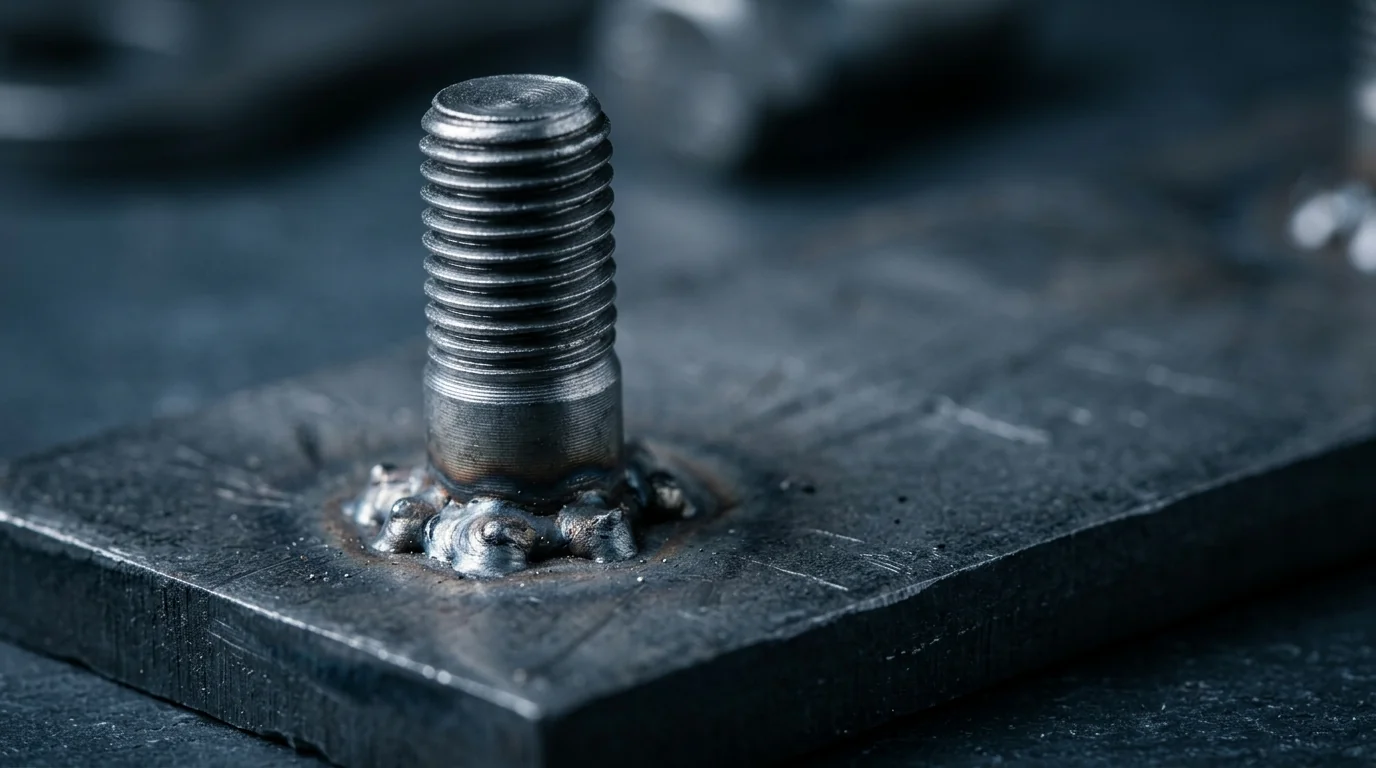
Projection welding groups by fastener geometry and the sheet it lands on; the acceptance metric is mechanical fastening — pull strength plus intact threads. Purely conductive-purpose resistance welds where contact resistance is the acceptance metric are covered separately on the electrical connections and fuses page. Recurring joint scope:
Projection welding is a resistance process — the workhorse and the only process that is properly “projection welding”. Multi-electrode heads fire the pulse through every projection at once; process controllers monitor pulse energy, force and expulsion signature per weld; parameter recipes lock per fastener grade and sheet thickness combination. See the resistance line →
Some non-standard geometries — studs on curved surfaces, or assemblies where two-sided electrode access is blocked — use laser stud-attach welding instead. Less common than the resistance workflow but a real option when the projection process simply cannot be tooled up. See the laser line →
Fits repair of damaged stud welds on a fabricated assembly and one-off or non-standard fastener geometries where a manual filler-added weld is more practical than tooling up a projection recipe for low-quantity work. See the pulse arc line →
Sample-first on the actual fastener grade, sheet thickness and projection geometry: the projection-to-force relationship does not port between fastener suppliers, so a recipe that fuses Brand A M6 studs cleanly may collapse or under-fuse Brand B M6 studs of the same nominal size. Small-batch and prototype fastener work overlaps with general industrial fabrication.
Four failure modes dominate projection-fastener programs, each traceable to the geometry-driven nature of the process:
Projection stud and nut welds get judged by pull-test values on the sample, not by weld appearance. The reliable route is a sample build on the actual fastener grade, sheet stack and projection geometry, run through pull-testing plus a thread-gauge check as the acceptance step. The evaluation itself is free.
Send a sample for free evaluation