Heating and cooling component welding covers the parts that move heat rather than produce it: fin-and-tube heat exchangers, heat pipe end seals, cold plate cover plate seams, refrigeration circuit tube joints, TEC bus tabs and vapor chambers. The through-line difficulty is that thin-wall stock (fin material at 0.1 mm is routine) must fuse cleanly across thousands of joints per assembly, and any leak on a sealed heat pipe or cold plate is a full-function failure — not a degraded state.
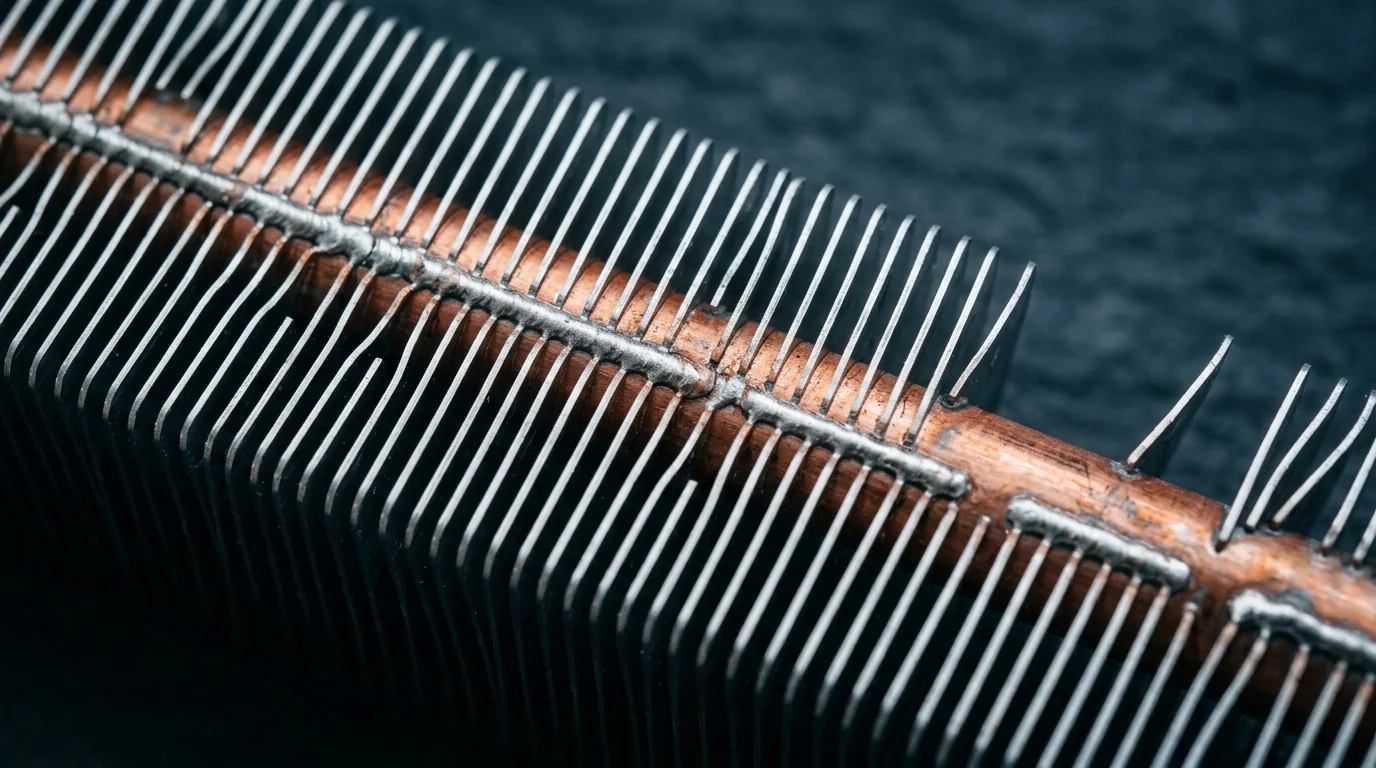
Heating and cooling equipment groups by function, not industry. Electrical heating elements — resistance wire and tubular heaters that generate heat — are covered on the heating elements page; this page owns the parts that move heat. Recurring joint scope:
Runs the fin-to-tube joints on automotive radiators and finned-tube coils (vacuum brazing is a common alternative for aluminum coil work), plus TEC bus-tab welds on ceramic carriers and small tank-to-core joints. Chosen for per-joint cycle time across long production runs. See the resistance spot line →
Dominant on hermetic joints where leak-tightness is non-negotiable — heat pipe end seals, cold plate cover plate seams, vapor chamber hermetic seams. Also handles Cu-Al dissimilar-metal fin work: short interaction time limits growth of brittle Cu-Al intermetallic at the interface. See the laser line →
Comes in on larger refrigeration circuit tube joints, on repair of heat exchangers and radiators in service, and on prototype cold plate builds where a small filler bead bridges fit-up variance. See the pulse arc line →
Sample-first is unavoidable: the parameter window sits on the actual fin gauge, tube alloy and fixture, and a zero-leak criterion means the pre-production check is a leak test on the assembled sample (helium leak or pressure-decay) — not a visual on the weld.
Four failure modes shape most heating and cooling welding programs, each traceable to a constraint ordinary welding practice does not have to design around:
Heating and cooling welding is decided on the actual fin gauge, tube alloy and fixture; parameter windows do not port across designs, and the acceptance step is a leak test on the assembled sample. The reliable route is a sample weld plus leak-check on your own materials — free.
Send a sample for free evaluation